Quality and technology IN CONSTRUCTION
delivered with STRAIGHT communication



A Gold Rush Without Windows – What Should the Construction Industry Do With the Data Center Boom?
Data centers are now the fastest-growing construction category worldwide, with power infrastructure right behind – electricity has become the new bottleneck. The boom offers rare margins and learning, but it hinges on a few tech giants' spending; the sensible play is to diversify and fix your data and contracts before buying the tools.
CONSTRUCTIONTRENDPROJECTMANAGEMENTFUTURESUSTAINABILITY
Dr. Toldy Gábor - Toldy Construct
7/3/20265 min read
A Gold Rush Without Windows – What Should the Construction Industry Do With the Data Center Boom?
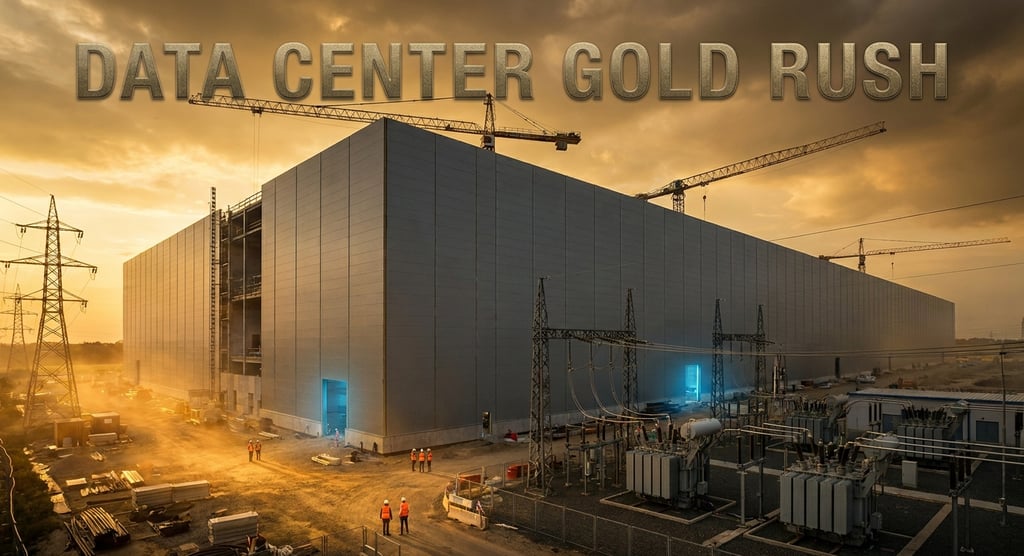
We live in a strange era: the most sought-after buildings in the world are almost empty of people. They have no windows, and from the outside they look plainer than a warehouse – yet this is what capital is queuing up for. In this year's Autodesk industry survey, the professionals polled named data centers as the fastest-growing construction category, with electricity infrastructure coming in second. It is no coincidence that the two sit side by side, but more on that later.
From a Hungarian perspective, this may at first sound like a distant, overseas story. It is not. The demand has arrived in Europe too, and because the segment is driven by a handful of very deep-pocketed technology companies, it is reshaping prices, capacities and the skilled-labor market even in places where not a single server hall is being built.
Why Contractors Are Scrambling for It
The appeal is easy to understand. In an industry that has spent the past few years at home battling a lack of orders, chains of unpaid invoices and wait-and-see paralysis – according to the ÉVOSZ business climate survey, 90 percent of Hungarian firms saw the market as unfavorable in 2025 – data center construction feels almost like salvation: the client is solvent, decides quickly, and since every day of delay means lost revenue on their side, they are willing to pay for a reliable contractor. According to Deloitte's engineering and construction outlook, this segment is also pulling prefabrication along with it: whatever can be manufactured in a factory is, and on site the work increasingly comes down to assembly. Whoever learns to work at this pace and to this precision can later sell that expertise on a housing estate or a factory floor as well.
So much for the pretty side. The less pretty side is that this demand depends on very few players. The investment decisions of a handful of global tech companies drive the whole thing, and those decisions follow the mood of the capital markets. If investor faith in artificial intelligence falters – and in the history of markets, waves of enthusiasm like this one invariably stall at some point – orders will not slow down; they will vanish. Anyone who by then has shifted their entire machine fleet, workforce and cash flow onto this single segment will have nowhere to retreat. It is an old lesson that somehow always has to be learned again: you cannot build a company on a single client, not even when that client happens to be the richest corporation in the world.
And there is a quieter side effect that gets less attention. Transformers, diesel generators, cooling equipment and good electricians go where they are paid the most. That pushes prices up across the rest of the market as well, making life even harder for, say, residential construction – something society needs far more urgently than yet more server halls.
Power Is the New Location
According to the old real estate cliché, three things matter in any development: location, location, location. For data centers, that sentence has been rewritten. Here, the value of a plot comes not from the view or the access roads, but from whether there is spare grid capacity nearby. In Western Europe, this is already a hard constraint: around Dublin, the regulator effectively froze new data center grid connections in 2021, because server farms were already consuming more than a fifth of the country's electricity, and the freeze was only lifted at the end of 2025, under strict conditions: new entrants must build their own generation or battery storage, and cover most of their consumption from newly built renewable sources. Similar tensions are visible around Frankfurt and Amsterdam, and even in a good year, large transformers now come with waiting lists measured in years.
This is also why electricity infrastructure construction is growing so fast: the two are sides of the same coin. Anyone who can build grid lines, substations and feed-in connections is guaranteed demand for the next decade – arguably a safer bet than the data center itself.
Meanwhile, it is hard not to notice the contradiction. The industry's other great watchword is energy efficiency: at home, too, everything revolves around cutting consumption, renovation, nearly zero-energy buildings. The data center wave pulls in exactly the opposite direction, with enormous electricity demand and, in many places, serious water needs. No sustainability report resolves this tension; waste-heat recovery and smart siting can ease it, but not explain it away.
Artificial Intelligence Inside the Fence
The other strand of the story is that AI is showing up not only as a client, but is also moving onto construction sites as a working tool. According to international surveys, roughly three-quarters of design and construction firms already use it in at least one project phase. Predictive scheduling, which learns from thousands of past projects to forecast likely delays, or camera-and-drone remote monitoring, which lets fewer people keep an eye on a site, genuinely saves money – and given the labor shortage, there is no question it will keep spreading.
Two things are worth adding, though, before anyone expects miracles. The first is that these systems are worth exactly as much as the data they learn from. And construction, let's be honest, ran for decades on paper, phone calls and memory. From messy, incomplete, retroactively prettified data, an algorithm does not produce intelligence – it produces confidently served error. At many companies, the data should be cleaned up first and the software bought second; in practice it usually happens the other way around, followed by disappointment and the phenomenon mockingly known as dashboard theater: management gazes at colorful dashboards while the real decisions are still made on gut feeling.
The second is that a camera watching a site sees not only the concrete but also the person pouring it. And that is a data protection and labor law question, not an IT one. Continuous monitoring of workers cannot be settled by purchasing a software license; whoever sorts it out afterwards, prompted by a complaint or a regulatory investigation, learns the lesson at a much higher price. Then there is the contractual question that most construction contracts today leave unanswered: if the schedule proposed by the AI turns out to be wrong, who bears the consequences of the delay? The software vendor, the general contractor, or the engineer who approved it? Until that is on paper, the risk belongs to whoever clicked last.
So What Follows From All This?
The data center wave will most likely last for years, and for anyone able to plug into it – whether as a supplier or in the grid construction that goes with it – it is a rare opportunity to learn and to earn a decent margin. The trap is not the boom itself but the attitude: whoever pivots to it merely because that is where the money is flowing right now will, at the next turn of the cycle, find themselves exactly where much of the industry stood not long ago – without work, sitting on top of expensively purchased machinery.
The sensible strategy is not a spectacular one. Stand on several legs, carry the precision learned on data center jobs over into the other segments, and get the data and the contracts in order before buying the digital tools. The point is to profit from the boom, not to depend on it.
Sources
Deloitte: 2026 Engineering and Construction Industry Outlook
TrueLook: Top Construction Technology Trends in 2026 (covering the findings of Autodesk's 2026 expert survey)
RIB Software: Construction Technology Trends 2026
Mapei / ÉVOSZ: Energy efficiency, digitalization, modular shift – construction in 2026 (in Hungarian)
Data Center Dynamics: EirGrid says no new applications for data centers in Dublin until 2028
DataCentre News: Ireland unveils strict new rules for data centre power use
Construction
With over 20 years of experience in general contracting, our company specializes in the flawless execution of unique, bespoke buildings. Our innovative methods and mindset make us stand out in the market.
Our services
Contacts
company@toldyconsult.hu
+36 30 289 2383
© 2024. All rights reserved.
Our WEBPAGES
www.toldyconsult.hu