Quality and technology IN CONSTRUCTION
delivered with STRAIGHT communication



Smart Home or Smoke and Mirrors? 10 Questions to Ask Before You Spend a Single Cent
A smart home is worth it only if it solves real problems—lower bills, better safety, and effortless comfort. If it’s just flashy gadgets and cloud dependence, it’s hype, not value.
CONSTRUCTIONTRENDPROJECTMANAGEMENTFUTURESUSTAINABILITY
Dr. Toldy Gábor - Toldy Construct
2/3/20262 min read
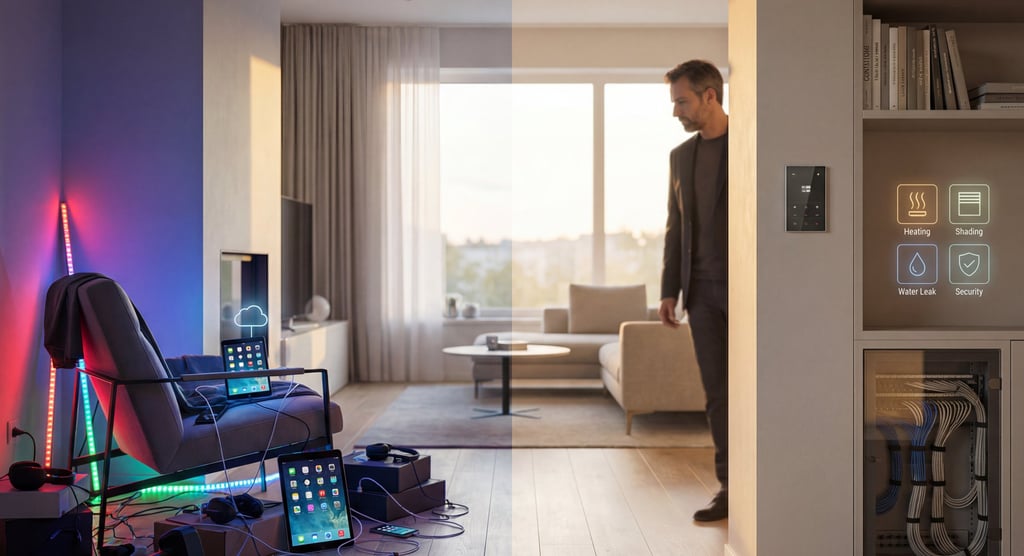

Smart Home or Smoke and Mirrors? 10 Questions to Ask Before You Spend a Single Cent
The smart home market today looks like a construction site where everyone is shouting—but very few are measuring. Marketing says “your toaster needs AI,” while in real life, a decent heating control setup is still sci-fi in a lot of homes. And right in the middle of those two worlds is your wallet.
The real question isn’t “Is it smart?”
It’s: Is it useful?
1) What exactly are you trying to solve?
If your answer is “because it’s cool,” you’re already heading in the wrong direction. Real goals look like this:
Lower bills (heating/cooling/shading)
Safety (water leaks, break-ins)
Comfort (automatic routines—not constant app tapping)
2) If the internet is down, does the house still work?
If you need “the cloud” to turn on a light, that’s not smart—it’s dependence. Local control isn’t a luxury feature. It’s a basic principle.
3) How much “lag” do you tolerate?
A light switch is instant. If your system “thinks” for 0.5–2 seconds, it will annoy you. And anything that’s annoying to use gets switched off sooner or later—mentally first, then literally.
4) Do you have one system—or eight apps?
“App fatigue” is the graveyard of smart homes. The goal is:
one logic, one interface, one accountable party.
5) How long will this stuff last?
We build buildings for decades. Many gadgets are built for 2–5 years (limited software support, battery swaps, new standards). That’s the classic trap of planned obsolescence.
6) Is there measurable payback?
“Feels nice” is not ROI. Payback starts where:
heating/cooling is intelligently controlled
shading is not decoration, but building physics
water damage prevention is automated
7) Can anyone operate it after you sell the property?
DIY smart setups often destroy value on the real estate market: buyers are afraid of them because they’re undocumented and hard to run.
8) Who is responsible for it?
If the answer is “a forum and a YouTube channel,” then congratulations—you’re the system integrator. Fine as a hobby. Not fine for an asset.
9) Which way is regulation pushing?
In Hungary, the 7/2006 TNM framework was replaced from November 1, 2023 by the 9/2023 (V.25.) ÉKM regulation.
Good insulation alone isn’t enough anymore: controllable building services and energy performance are increasingly expected.
10) Does the house help invisibly—or constantly nag you?
A good smart home doesn’t talk, blink, or bother you. It optimizes quietly. That’s engineering quality.
Verdict: a smart home becomes valuable when it solves real problems, not when it just looks smart.
Source:
National Legislation Database (Nemzeti Jogszabálytár). 7/2006. (V. 24.) TNM Decree on the Energy Performance of Buildings (Hungary). (Referenced for the regulatory background; later framework changes noted in the article.)
Connectivity Standards Alliance (CSA). Matter: Smart Home Connectivity Standard (overview / specification background).
NXP Semiconductors. Why Smart Home Interoperability Matters (interoperability context and “one system vs many apps” pain point).
AppleInsider. Worst & weirdest at CES 2025 — Robotic owls, phone toasters, & unnecessary AI (examples of “solution looking for a problem”).
Evan Bartlett. The failure of smart homes (user-experience friction, “app fatigue” concept).
Construction
With over 20 years of experience in general contracting, our company specializes in the flawless execution of unique, bespoke buildings. Our innovative methods and mindset make us stand out in the market.
Our services
Contacts
company@toldyconsult.hu
+36 30 289 2383
© 2024. All rights reserved.
Our WEBPAGES
www.toldyconsult.hu